Why Kids Melt Down After School, and a 5-Minute Reset That Helps
Your child gets in the car, and within minutes there are tears over the wrong snack, a sock that feels weird or a sibling who looked at them funny. Their teacher says they had a great day. So what happened?
If this sounds familiar, you're not alone, and your child isn't being difficult on purpose. This pattern is so common it has a name: after-school restraint collapse.
Why it happens
School asks a lot of kids. For six or seven (yeah I said it) hours, they follow directions, wait their turn, sit still, tune out noise and keep big feelings in check. That takes effort, especially for younger kids who are still learning how to do all of it.
By pickup, that effort has run out. When kids finally get to be with the people who feel safest, their bodies let go of everything they've been holding in. In a way, the meltdown is a compliment. It means home is where they feel safe enough to fall apart.
Hunger, tiredness and the sudden drop in structure make it harder. Most kids aren't ready for questions about their day the second they walk out the door.
What helps
The goal isn't to stop the feelings. It's to help your child's body shift from on alert to calm, so they can come back to themselves. Movement and slow breathing are two of the quickest ways to get there.
Here's a five-minute reset you can do in the car before you pull out of the pickup line, or in the kitchen as soon as you get home.
The 5-minute after-school reset
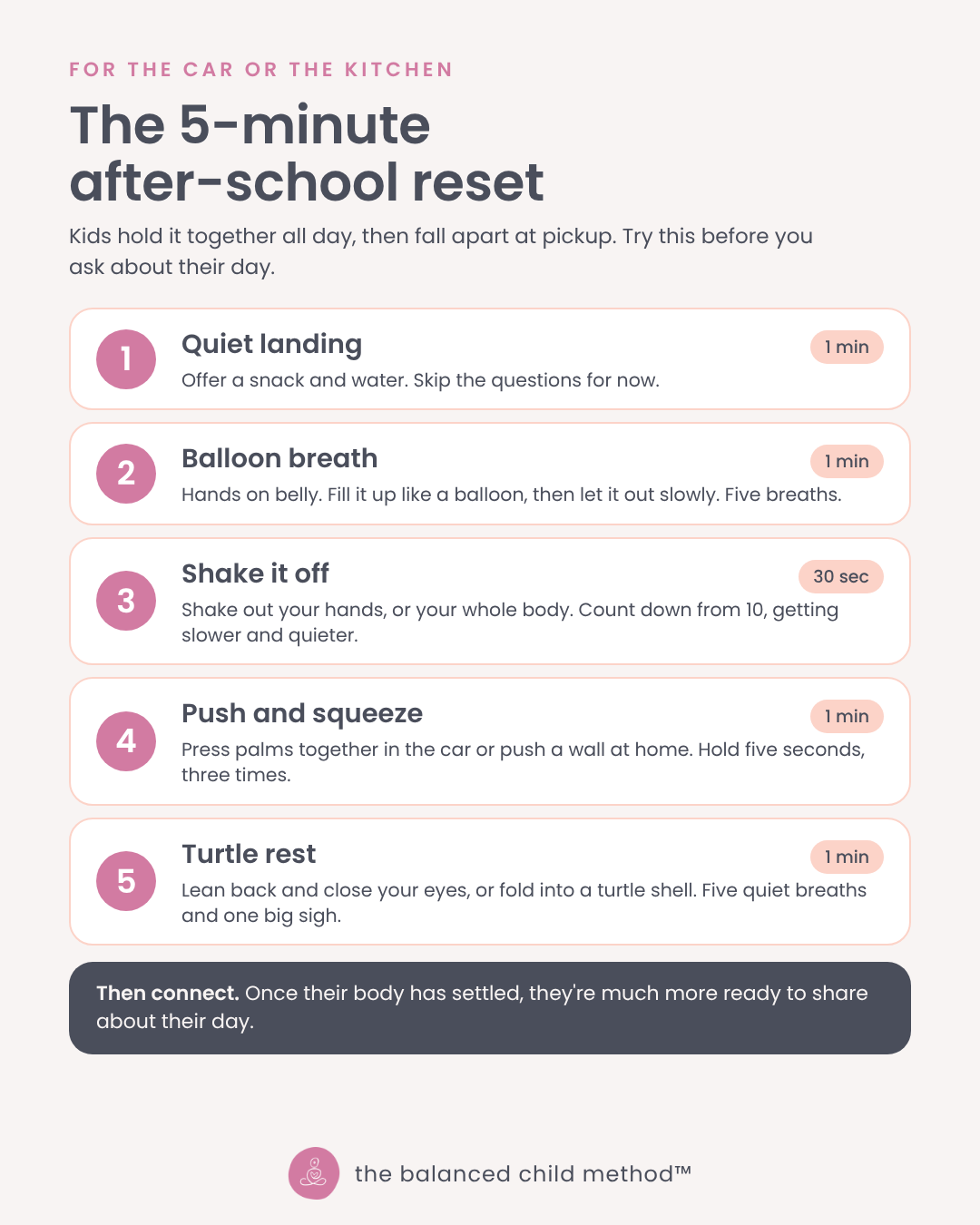
1. Quiet landing (one minute)
Before anything else, offer water and a snack, and give your child a little quiet. Skip "How was your day?" for now. A simple "I'm so glad to see you" is plenty.
2. Balloon breath (one minute)
Place your hands on your belly. Breathe in through your nose and fill your belly up like a balloon. Then breathe out slowly through your mouth, like you're letting the air out. Take five slow breaths together.
3. Shake it off (30 seconds)
In the car, shake out your hands and wiggle your fingers. In the kitchen, shake your whole body: hands, arms, legs and shoulders. Count down together from 10, getting slower and quieter as you go, until you're completely still at one.
4. Push and squeeze (one minute)
In the car, press your palms together hard in front of your chest for five seconds, then let go. In the kitchen, stand facing a wall, put both hands on it and push like you're trying to move it. Hold for five seconds, then release. Repeat three times.
Pushing against something solid helps the body feel grounded, and many kids find it calming.
5. Turtle rest (one minute)
In the car, lean your head back, close your eyes and rest your hands in your lap. In the kitchen, kneel on the floor, fold forward and rest your forehead down like a turtle tucked into its shell. Take five quiet breaths, then finish with one big sigh together.
Once your child feels calmer, that's the time to connect. You might be surprised how much more they share after their body has had a chance to settle.
A few tips
Do it with them. Kids calm down faster when a grown-up is breathing right alongside them.
Keep it the same every day. A predictable routine becomes a signal that it's time to downshift.
Let your child lead. Some days they'll want all five steps. Other days, the snack and quiet are enough.
Save big conversations for later, like dinner or bedtime, when they've had time to recharge.
If meltdowns are frequent or feel more intense than usual, check in with your child's teacher or pediatrician.
A softer landing
After-school meltdowns are hard on everyone. A few minutes of breath and movement won't make every afternoon perfect, but it can give your child, and you, a softer landing.
Try the reset this week and let us know how it goes. We'd love to hear what works in your house.
Want more tools like this? We bring breathing and movement to schools, daycares and libraries across central Ohio. Check out our public classes and events, or contact us to bring The Balanced Child Method to your child's school.